
Mobile Crane Essentials: Types, Uses, and Benefits
A mobile crane is a heavy-duty lifting machine designed to travel to a worksite and lift heavy loads with minimal setupen.wikipedia.org. It typically mounts on a truck, crawler, or all-terrain chassis, and uses a telescoping boom and cable system for liftingen.wikipedia.org. Modern mobile cranes arrive on site ready to use, needing little or no assembly before operation. They greatly boost construction and industrial productivity by moving large loads efficiently across short distancesuplifter.com. For example, instead of using fixed cranes, crews often deploy mobile cranes to reach confined areas or quickly relocate between sitesuplifter.com.

Mobile cranes come in many types, each built for specific tasks. Common varieties include crawler cranes (tracked mobile cranes), all-terrain cranes (dual-mode road/off-road), rough-terrain cranes, truck-mounted telescopic cranes, carry-deck cranes, and pick-and-carry cranesheavyequipmentcollege.edu. Each type has unique strengths: some (like crawler cranes) offer extreme lifting power and off-road stability, while others (like pick-and-carry cranes) excel in tight indoor or urban sitesheavyequipmentcollege.eduseeraj.in. The diverse range ensures there is a suitable mobile crane for virtually every lifting need. For clarity, here are key mobile crane categories:
- Crawler Cranes – Heavy cranes on tracks, providing superior stability and very high capacity for uneven terrainseeraj.in. (Example: Seeraj’s fleet ranges from 15 to 1250 tons in crawler cranesseeraj.in.)
- All-Terrain (Truck) Cranes – Versatile cranes that combine highway mobility with off-road capability, using multi-axle wheels and a telescopic boom.
- Rough Terrain Cranes – Smaller four-wheel (often all-terrain) cranes with powerful hydraulics, designed for off-road use in construction yards.
- Truck-Mounted (Telescopic) Cranes – Crane booms mounted on standard trucks; they drive on public roads and set up quickly for jobs on-site.
- Carry-Deck Cranes – Compact cranes with a small boom and a deck for transporting loads; useful in factories or shipyards.
- Pick-and-Carry Cranes – Very mobile small cranes (15–23 ton), whose boom can lift without outriggers, allowing them to pick and carry loads short distances indoors or on congested sitesseeraj.in.
Each type can be linked to further details. For instance, a detailed page on Seeraj Group’s Hydraulic Crawler Cranesseeraj.in explains how those cranes offer unmatched stability. Similarly, their Pick and Carry Cranes pageseeraj.in highlights compact mobility. (In practice, anchor text like “Hydraulic Crawler Cranes” or “Pick and Carry Cranes” would link internally to those Seeraj pages.)
Key Components of a Mobile Crane
Mobile cranes share common features: a telescopic boom, a hydraulic winch and cable system, a rotating upper structure (superstructure), and outriggers for stability. The boom extends in sections, allowing the crane to reach high or far distances. Mobile cranes use hydraulic power to operate the boom and winch, giving smooth control over heavy loadsen.wikipedia.org. Importantly, outriggers (extendable legs) spread out from the chassis to stabilize the crane during lifts; they level the machine on uneven ground and prevent tippinguplifter.com.
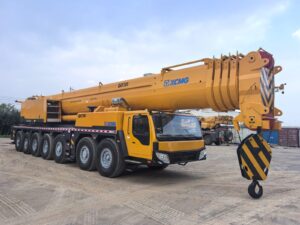
Mobile crane controls and safety systems are typically advanced. Many have load sensors, emergency brakes, and operator cabins designed for visibility and ergonomicsuplifter.com. Some feature computerized load-moment indicators to help the operator avoid unsafe lifts. Because mobile cranes travel under their own power, they also carry an engine (diesel or electric) and travel gearbox. This self-propelled design is what sets mobile cranes apart from fixed cranes, enabling rapid relocation. In summary, the combination of a powerful telescoping boom, robust hydraulics, and stabilizing outriggers lets mobile cranes lift large loads with precision and safetyen.wikipedia.orguplifter.com.
Advantages of Mobile Cranes
Mobile cranes offer several key advantages over other lifting methods. Their foremost benefit is mobility and fast setup: a crane on wheels or tracks can drive directly to a new location on the same site, or even travel long distances on highways, saving time and transport costsen.wikipedia.orgheavyequipmentcollege.edu. By contrast, fixed cranes (like tower cranes) must be assembled on-site, which can take days or weeks. Because mobile cranes require little assembly, projects start lifting tasks immediately upon arrivalen.wikipedia.orgheavyequipmentcollege.edu.
- Efficiency & Productivity – Mobile cranes dramatically speed up lifting tasks. They can lift heavy loads quickly with fewer personnel, reducing manual labor and project delaysuplifter.comuplifter.com. For example, able to access tight spaces and maneuver easily, mobile cranes help complete construction phases fasteruplifter.com.
- Versatility – The same crane can handle many jobs. A mobile crane can traverse rough ground or narrow streets that a fixed crane cannot. Its ability to travel to different sites means one machine can serve multiple projectsuplifter.comheavyequipmentcollege.edu.
- Cost Savings – Using mobile cranes often lowers costs. Owners save on building special foundations required by tower cranes. Crane rental operators reduce the need for extra cranes at multiple sites by moving one unit as neededuplifter.comuplifter.com.
- Safety – Modern mobile cranes include safety features (like load monitors and anti-collision systems) and follow strict standards. Proper use of outriggers and load charts greatly reduces accidentsuplifter.comheavyequipmentcollege.edu. By mechanizing heavy lifts, mobile cranes also reduce the risk of manual lifting injuries.
- Flexibility in Space – Many mobile cranes (especially rough-terrain and pick-and-carry types) can operate in confined or crowded sites where larger cranes cannot reachheavyequipmentcollege.eduuplifter.com. This agility is crucial in urban or indoor projects.
Overall, the combination of mobility, power, and versatility makes mobile cranes indispensable. They deliver “lifting possibilities” for diverse projects, which is why companies like SEERAJ emphasize a wide range of mobile cranes in their fleetseeraj.inseeraj.in.
Mobile Crane Applications
Mobile cranes serve in virtually every industry involving heavy loads. Common applications include:
- Construction & Infrastructure: Erecting steel structures, placing precast concrete, building bridges and metro systems. (Seeraj’s crawler cranes, for example, support metro rail and pipeline projectsseeraj.in.)
- Industrial & Manufacturing: Moving large equipment, assembling machinery, or installing factory components.
- Energy Sector: Setting up wind turbines, oil & gas platforms, or power plant components.
- Ports & Shipping: Loading and unloading cargo, containers, and heavy machinery from ships and trucks.
- Mining & Utilities: Handling oversized equipment in mining sites or installing utility poles and towers.
- Emergency & Special Projects: Cleanup, disaster response, or film/stage rigging where a temporary crane is needed.
In each case, the mobile crane’s ability to reach over obstacles and rapidly reposition is invaluable. For example, the Uplifter case study notes that construction and manufacturing industries rely on mobile cranes for material handling and maintenanceuplifter.com. Likewise, Seeraj’s clients use its cranes for flagship infrastructure projects—rail, highways, industrial plants—knowing the cranes will arrive and lift safelyseeraj.inseeraj.in.
Choosing and Operating Mobile Cranes Safely
When selecting a mobile crane, key factors include lift capacity, boom length/reach, terrain, and site constraintsuplifter.comheavyequipmentcollege.edu. The crane must have enough capacity at the required radius (reach) for the heaviest loads. Rough terrain or off-road work may favor crawler cranes or rough-terrain cranes, while highway travel needs truck or all-terrain cranes. Operators also consider ease of setup and transport permits (overweight or oversized loads may restrict highway movement).
Safety is paramount. Operators and riggers must be certified and follow the crane’s load charts. Daily inspections, proper outrigger setup, and communication (signals) ensure safe liftsheavyequipmentcollege.eduuplifter.com. Common guidelines (such as OSHA’s crane standards) mandate routine checks and training. Ultimately, good planning and experienced crews are as important as the crane itself.
Mobile crane operators must never override safety devices. Modern cranes have interlocks to prevent lifting beyond safe limits and sensors to warn of overloadsuplifter.com. When properly used, mobile cranes minimize accidents: they reduce the need for risky manual lifts and enable mechanized handling even in tight spaces, creating a safer work environmentuplifter.comheavyequipmentcollege.edu.
Summary
In summary, the mobile crane is an essential tool for modern lifting. Its main strengths are quick mobilization and versatile lifting poweren.wikipedia.orguplifter.com. From heavy crawler cranes to compact pick-and-carry models, mobile cranes adapt to many tasks. They greatly enhance project efficiency and flexibility while maintaining safety standardsuplifter.comuplifter.com. When planning a project, choosing the right mobile crane ensures that heavy materials are handled smoothly, on time, and on budget. With experts like Seeraj Group providing a full range of mobile crane options (hydraulic crawler, tyre-mounted, pick-and-carry, etc.), sites across India can lift heavier and build faster than everseeraj.inseeraj.in.